The bond market's recent repricing may reflect a simple question: where are the limits? Economic growth has remained remarkably resilient despite higher rates, while fiscal deficits, Treasury issuance, and AI-related investment continue to expand. Markets have been willing to finance that growth, but higher yields suggest investors are demanding greater compensation to do so. That move higher may say less about inflation fears than about the growing cost of financing an economy that continues to exceed expectations. The debate may no longer be around the durability of the growth, but how much markets are willing to fund growth, borrowing, and investment before requiring an even higher price.

- Persistent inflation pressures and signs of labor market weakness complicated the monetary policy outlook, as investors continued to anticipate further Fed tightening but reduced expectations for an October rate hike
- The ISM Prices Paid Index rose to 74.0, its highest level since July 2022, signaling rising input costs that could feed through to consumer inflation
- The US economy added 29k jobs in September, below expectations, as employers appeared increasingly cautious amid economic and policy uncertainty
- The September FOMC meeting minutes highlighted broad support for the recent rate hike, as policymakers remained focused on containing ongoing inflation pressures
- Signs of labor market softness caused investors to lower expectations of an October hike, with the market-implied probability falling from 37% to 19%
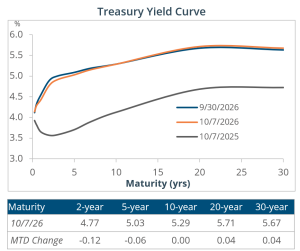
- The Treasury curve steepened month-to-date as investors reassessed the likelihood for near-term tightening, while longer-term yields remained sensitive to inflation and fiscal concerns
- Strong demand at the 10-year Treasury auction suggested investors found value at elevated yields, with non-dealer bidders absorbing more than 97% of the offering
- Elevated all-in yields and a softer market tone kept many borrowers on the sidelines, with investment-grade (IG) issuance totaling just $10 billion versus estimates of at least $25 billion; high-yield (HY) supply was roughly $2 billion
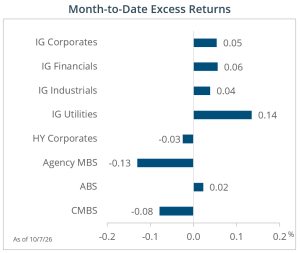
- Corporate spreads stabilized following last month’s widening, with IG spreads unchanged at 80bps month-to-date and HY spreads tightening 6bps to 305bps
- Asset-backed securities (ABS) outperformed Treasuries, despite robust primary market activity with over $10 billion pricing across 16 deals
- Municipals largely kept pace with Treasuries as muni/Treasury ratios moved by roughly 1% or less