Consistency helps build credibility, but investors need to understand what the Fed is responding to. Just two weeks after the Federal Reserve (Fed) held rates steady, markets now anticipate a December hike and see a strong likelihood of another in January. Has the outlook materially changed, or has the case for further tightening simply become harder to dismiss? Changing expectations do not necessarily signal inconsistent policy, but limited communication makes the distinction harder to determine. Although volatility has remained largely contained, uncertainty about what would prompt the Fed to act could amplify reactions to incoming data. For us, that reinforces the value of maintaining portfolio flexibility and not positioning for any one outcome.

- The holiday-shortened week was not short on market-moving developments, as stronger labor data and persistent inflation reinforced expectations for a more restrictive policy path
- Inflation exceeded expectations in October, with headline CPI rising 0.4% versus estimates of 0.3%, while core CPI increased 0.3% versus forecasts of 0.2%
- October nonfarm payrolls increased by 165k, well above expectations of 70k, while upward revisions to prior months and a decline in unemployment to 4.1% reinforced signs of labor market resilience
- Several FOMC officials signaled support for additional tightening in December, with some leaving open the possibility of a larger increase should inflation pressures intensify
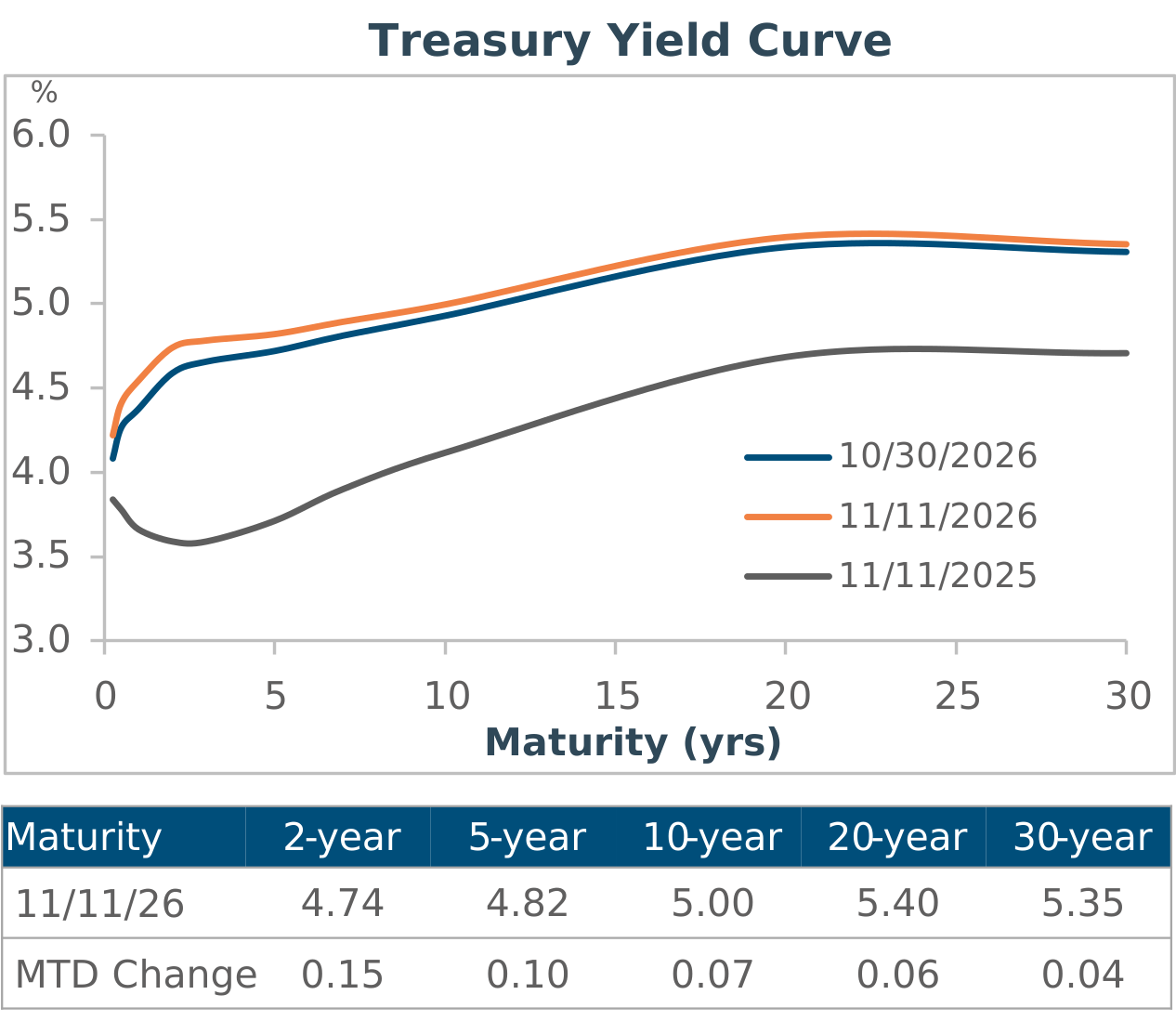
- Treasury yields rose across the curve, led by the front-end as investors repriced the expected path of monetary policy
- The 2-year Treasury yield rose 16bps to 4.74%, while the market-implied probability of at least two 25bp rate hikes by January jumped from 7% to 82%
- Corporates remained resilient despite expectations for an increasingly hawkish outlook, with investment-grade (IG) and high-yield (HY) spreads tightening 1bp and 4bps to 88bps and 320bps, respectively
- Investment-grade supply totaled roughly $42 billion week-to-date, compared to estimates of $40 billion; issuance has surpassed $117 billion month-to-date and is only $20 billion away from a new November record
- The high-yield primary market remained active among BB- and B-rated issuers, with three deals totaling roughly $2 billion
- Agency mortgage-backed securities (MBS) underperformed Treasuries amid the CPI-driven rise in rate volatility; meanwhile, the 30-year mortgage rate continued to decline from October’s peak of 7.53%, to 7.24%
- Investors withdrew roughly $104 million from municipal mutual funds and ETFs last week; fund flows have rotated between inflows and outflows for each of the past eleven weeks