- Risk assets remained relatively stable as volatility decreased compared
to earlier in the month, while economic data continued to show a less
confident consumer- The S&P 500 rose on the week despite a dip on Wednesday,
as President Trump proceeded with a 25% tariff on automakers
and suggested new levies on Canada and the European Union - Consumer confidence, as measured by the Conference Board,
stood at 92.9 – its lowest point since early 2021 – amid
economic policy uncertainty and a rise in inflation expectations - Labor market data held steady as both initial jobless claims and
continuing claims came in slightly below expectations, at
224,000 and 1,856,000, respectively
- The S&P 500 rose on the week despite a dip on Wednesday,
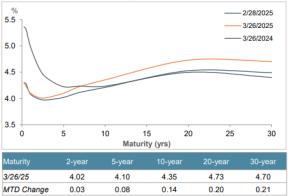
- The Treasury yield curve steepened, with the 30-year rate increasing
by 15bps week-over-week, while shorter tenors rose modestly - Both investment-grade and high-yield primary markets saw heightened
activity as issuers rushed to sell debt amid worries that a potential
slowdown in growth could reduce investor risk appetite- Investment-grade issuance totaled $41 billion, surpassing
expectations of $30 billion, and high-yield borrowers brought
roughly $5 billion of new deals to the market
- Investment-grade issuance totaled $41 billion, surpassing
- Investment-grade spreads widened by 1bp week-over-week to 90bps,
with yields increasing by 9bps to 5.23%; high-yield spreads remained
unchanged at 314bps, and yields increased by 4bps to 7.57% - Agency mortgage-backed securities (MBS) underperformed other
securitized sectors, with spreads widening by 1bp to 36bps- Delinquencies rose among first-time homebuyers amid
declining housing affordability
- Delinquencies rose among first-time homebuyers amid
- Municipal bond funds recorded $19 million of inflows last week,
marking five consecutive weeks of positive flows; Muni/Treasury ratios
rose across the curve, except for the 30-year tenor
Treasury Yield Curve
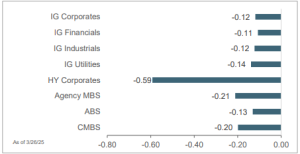
Month-to-Date Excess Returns