Weekly Fixed Income Market Update: January 15, 2026

2 min read
Share this post
Printable Version

  • Recent headlines focused on proposed Trump administration policies, including a ban on institutional investors purchasing single-family homes, increased Fannie Mae and Freddie Mac mortgage purchases, and a suggested 10% cap on credit-card interest rates – which could boost housing affordability and reinforce consumer balance sheets
  • This week's economic data was likely not enough to convince the Federal Reserve (Fed) to ease monetary policy further at the January meeting, with the next rate cut expected in July
    • Non-farm payrolls increased by 50,000 in December, below consensus estimates of 70,000; this figure was accompanied by a downward revision in October and November’s figures by 76,000, suggesting that labor demand is decelerating
    • The unemployment rate, however, fell to 4.4%, reflecting a combination of fewer outright job losses and people returning to the workforce
    • CPI rose 0.3% month-over-month in December, in line with expectations, as stronger-than-expected food inflation offset softer areas
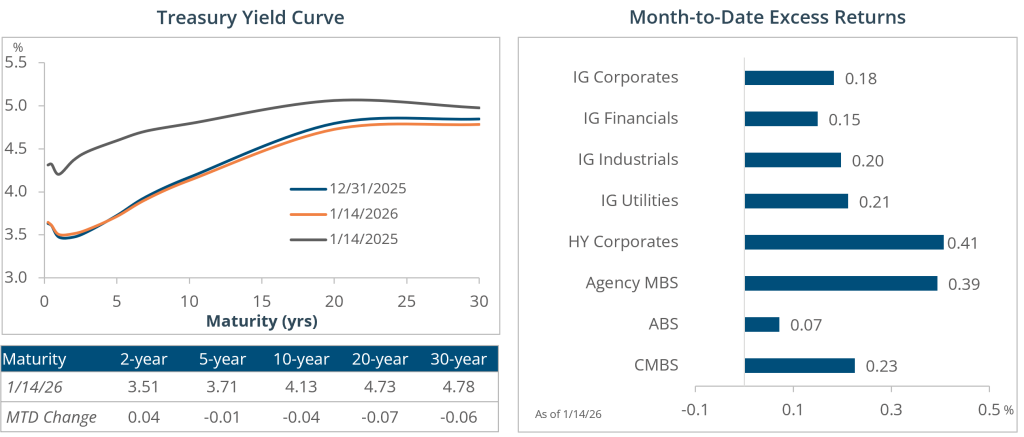
  • The Treasury curve flattened as the market pushed out the expected date of the Fed’s next rate cut from June to July
    • The 2-year Treasury rate rose 4bps to 3.51%, while the 30-year yield fell 5bps to 4.78%
  • Investment-grade (IG) corporate issuance of roughly $59 billion was relatively quiet compared to the recent record-setting totals and below expectations of $60 billion; deals were met with strong demand as issuers paid flat to negative concessions
    • Investment-grade corporate spreads tightened 2bps to 76bps, while yields remained unchanged at 4.81%
  • High-yield (HY) issuers remained active despite higher all-in yields, with supply totaling just shy of $3 billion on the week
    • High-yield corporate spreads tightened 1bp to 260bps, while yields rose 13bps to 6.60%
  • President Trump’s directive for Fannie Mae and Freddie Mac to purchase $200 billion of mortgage bonds drove MBS spreads tighter to 14bps, a four-year low, before ending the week 7bps tighter week-over-week at 17bps
  • Short and intermediate duration municipals outperformed Treasuries, as the 2-year and 10-year muni/Treasury ratios fell from 66.7% and 63.0% to 64.5% and 62.8%, respectively


Sources: Bloomberg and Bloomberg Index Services Limited. All commentary and data as of 1/15/26 unless otherwise noted. Excess returns are the curve-adjusted excess return of a given index relative to a term structure-matched position in Treasuries. The views contained in this report are those of IR+M and are based on information obtained by IR+M from sources that are believed to be reliable but IR+M makes no guarantee as to the accuracy or completeness of the underlying third-party data used to form IR+M’s views and opinions. This report is for informational purposes only and is not intended to provide specific advice, recommendations, or projected returns for any particular IR+M product. No part of this material may be reproduced in any form, or referred to in any other publication, without express written permission from Income Research + Management. “Bloomberg®” and Bloomberg Indices are service marks of Bloomberg Finance L.P. and its affiliates, including Bloomberg Index Services Limited (“BISL”), the administrator of the index (collectively, “Bloomberg”) and have been licensed for use for certain purposes by IR+M. Bloomberg is not affiliated with IR+M, and Bloomberg does not approve, endorse, review, or recommend the products described herein. Bloomberg does not guarantee the timeliness, accurateness, or completeness of any data or information relating to any IR+M product.

Share this post

Related posts

View All
6 min read

Bond Appétit - The Active Manager's Discerning Palate

4 min read

The Next Hundred Days and Beyond

3 min read

Cashing In On Your Second Chance

As of 12/31/25 unless otherwise stated. Personnel as of 1/2/26.
@ 2026 Income Research + Management. All Rights Reserved.
chevron-down