Monthly Fixed Income Market Update: September 2025

2 min read
Share this post
Printable Version


  • After keeping the fed funds target rate range at 4.25% – 4.50% all year, the Federal Reserve (Fed) delivered a 25bp rate cut at its September FOMC meeting, characterized as a risk management cut and insurance against further labor market weakness
    • August’s nonfarm payrolls report came in below consensus estimates, increasing 22,000 versus 75,000, respectively; this was accompanied by a downward revision in June’s and July’s figures, which brought year-to-date adjustments to 366,000
    • Inflation remained in an uptrend with CPI and PCE growing 2.9% and 2.7%, respectively, year-over-year
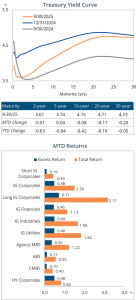
  • The Treasury curve flattened in September as longer-term yields declined in response to signs of weakening employment data
    • In September, the 30-year Treasury yield initially declined to 4.65% before climbing to 4.73% and finishing 20bps lower month-over-month
  • Investment-grade (IG) and high-yield (HY) corporate spreads tightened by 5bps to 74bps and 267bps, respectively
    • In September, long corporates were one of the best performing sectors as issuers continue to favor issuing short- and intermediate-term debt amid elevated yields; lower-quality issuers outperformed higher-quality issuers, with CCCs outperforming BBs by 19bps
    • Heavy IG and HY supply resulted in some of the busiest months on record as issuers took advantage of lower yields and tight spreads; IG and HY issuance surpassed dealer estimates and totaled $207 billion and $58 billion, respectively
  • Agency mortgage-backed securities (MBS) outperformed other securitized sectors on the prospect of more bank demand; spreads reached as low as 28bps intra-month - driven by the Fed’s policy decision - before closing at 31bps, 3bps tighter month-over-month
  • Municipal bonds outperformed Treasuries as muni/Treasury ratios fell, particularly in the long end of the curve; the 10-year muni/Treasury ratio declined 6% month-over-month to 70%
    • Consistent inflows into mutual funds and ETFs helped soak up the $39 billion in municipal new issue supply during the month


As of: 9/30/25. Sources: Bloomberg

Excess returns are the curve-adjusted excess return of a given index relative to a term structure-matched position in Treasuries. This is not a recommendation to purchase or sell the securities mentioned above.

The views contained in this report are those of Income Research + Management (“IR+M”) and are based on information obtained by IR+M from sources that are believed to be reliable but IR+M makes no guarantee as to the accuracy or completeness of the underlying third-party data used to form IR+M’s views and opinions. This report is for informational purposes only and is not intended to provide specific advice, recommendations, or projected returns for any particular IR+M product. No part of this material may be reproduced in any form, or referred to in any other publication, without express written permission from Income Research + Management. “Bloomberg®” and Bloomberg Indices are service marks of Bloomberg Finance L.P. and its affiliates, including Bloomberg Index Services Limited (“BISL”), the administrator of the index (collectively, “Bloomberg”) and have been licensed for use for certain purposes by IR+M. Bloomberg is not affiliated with IR+M, and Bloomberg does not approve, endorse, review, or recommend the products described herein. Bloomberg does not guarantee the timeliness, accurateness, or completeness of any data or information relating to any IR+M product.

Share this post

Related posts

View All
6 min read

Bond Appétit - The Active Manager's Discerning Palate

4 min read

The Next Hundred Days and Beyond

3 min read

Cashing In On Your Second Chance

As of 12/31/25 unless otherwise stated. Personnel as of 1/27/26.
@ 2026 Income Research + Management. All Rights Reserved.
chevron-down