As AI rapidly moves from a technology narrative to a major driver of economic growth, credit markets are financing much of the expansion. The AI buildout has already rewired parts of the fixed income market by altering index composition, increasing dispersion, and prompting issuers to introduce new structures. With demand for compute continuing to outpace supply, many expect investment to remain elevated. Yet this pace of change feels unprecedented. Recent volatility shows how quickly the narrative, and the underlying assumptions, can shift as new information emerges and sentiment swings. As the focus transitions from investment to monetization, the central question could migrate from how much capital is needed to whether that capital can produce a return on investment. As the range of issuers, structures, and risks expands and assumptions shift, we believe that selectivity becomes increasingly important.
Built on Bonds
The AI buildout is a story about capital. 2026 may be remembered less for a particular AI model or chip advance than for the scale of investment in AI. The AI capex cycle is being led by Hyperscalers, who are on pace to spend over $893 billion this year, exceeding the cumulative total from the preceding three years.
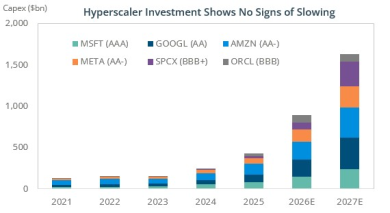
And this could just be the start. Companies must invest significantly today to meet expected demand and support future revenue growth. As a result, capex guidance has been continuously revised upward as AI demand has so far outpaced available compute. Next year’s estimates have risen substantially since March, climbing over $530 billion to roughly $1.6 trillion, and if demand and monetization hold up, that trend could continue as data center construction transitions to equipping them with compute capacity. Guidance is only as durable as the optimism behind it, however, and recent volatility shows how quickly that can shift.
Credit markets are helping finance the growth. As capital needs have increased, Hyperscalers have frequently relied on the corporate bond market to supplement for what had historically been funded through operating cash flow. Year to date, Hyperscalers have issued more than $230 billion of USD corporate debt, representing roughly 12% of investment-grade issuance. Total AI-related supply extends further through utilities, REITs, semiconductor companies, and data-center developers, as well as convertible bonds and preferred securities. Heavy issuance is expected going forward, but it is not guaranteed. If investment slows or if companies fund more of the spending from free cash flow, debt issuance could underwhelm.

Corporate bonds are not the only funding source. Borrowers are also tapping non-USD, public, private, loan, and securitized markets, while some are issuing across multiple different markets to avoid overwhelming investors. The securitized markets have long been utilized by sponsors for stabilized, fully operational data centers, whereas the project finance sector has brought several jumbo deals to finance new data centers, requiring a combination of private syndication, insurance capital, and public markets.
A Changing Market Landscape

A growing presence. Hyperscalers have become some of the largest corporate bond issuers, with annual issuance rivaling that of money-center banks and cable companies. Their share of the corporate market could approach 10% in the coming years if current spending plans hold, making their future funding needs increasingly consequential for investors. Hyperscaler issuance has also skewed long, with an average tenor of new debt of roughly 15 years, compared with 9 years for the rest of the corporate market. That longer duration can amplify the pricing and volatility impact of Hyperscalers, while making them an even larger slice of the long-end of the market and in A-rated-or-better indices.
Benchmarks only tell part of the story. Traditional indices omit parts of the AI ecosystem, such as project finance, data center asset-backed securities (ABS), and single-asset single-borrower data center commercial mortgage-backed securities (CMBS). Index weights alone understate the size and impact of the AI buildout with these sectors totaling over $131 billion, compared to $477 billion for Hyperscalers.
Lines between sectors blurring. The project finance sector has grown in popularity as a creative source of capital. These securities are tied to a new, soon-to-be constructed data center, with the tenant, often a Hyperscaler, offering a partial or full credit backstop during the construction phase. These transactions blend characteristics of corporate and securitized debt. Amortization and lease structures distinguish them from traditional corporate bonds, while their construction risk and size are unusual for the securitized market. The result is securities exposed to the same company but offering very different credit risks, structural protections, and compensation.
From Investment to Monetization
 The next test is execution. As more data center shells become operational, spending will shift to computing equipment inside the data centers. This transition lends itself to more asset-level financing, such as chip-backed deals, and raises new questions such as residual values. The next phase will therefore be measured by whether projects can produce durable cash flow to service debt, rather than by how much capital can be raised.
Competition and bottlenecks. Capital alone may not be enough to guarantee success. Power availability, permitting delays, and public opposition can delay operations and determine when a data center can inevitably begin generating revenue. The location of a data center, the surrounding political landscape, and the ability to access or generate power all add to the many layers of credit analysis required to assess new data center deals. Even once operational, the proliferation of low-cost models may require some companies to invest even more in these projects to create capacity and remain competitive.
Investors are demanding more compensation. The market’s expectations for more supply and the uncertainty around long-term economics have pushed risk premiums higher. Hyperscalers historically traded considerably tighter than the broader market, but that relationship has reversed given the technical pressures of repeated issuance. Wider spreads do not necessarily signal weaker fundamentals, although it may suggest balance sheets alone cannot insulate high-quality issuers. Slower supply would ease the technical pressure, while weaker demand for AI would raise fundamental questions. As progress towards monetization becomes clearer, valuations should increasingly reflect differences in cash flows, tenants, leverage, and construction risks.
Looking Across the AI Ecosystem
A broader, holistic view. AI-related financing spans much of the fixed income market, but the most attractive risk-adjusted opportunity may not be apparent when each sector is evaluated in isolation. We rely on cross-sector collaboration to compare securities across the AI financing continuum including those exposed to the same companies and projects. By assessing differences in structure, cash flow, and compensation across sectors, we seek to identify where investors are being appropriately paid for the underlying risks.

Markets are increasingly interconnected, but highly nuanced. The same company can sit behind multiple securities, but differences in structure can result in very different credit risks. Construction, lease terms, amortization, and residual value can materially impact the relative credit quality and structural protections between the two securities. For example, a fully amortizing security may reduce refinancing and residual-value risk, while a bullet maturity may leave more of those risks at maturity. The objective is to understand where the risk resides and determine the most attractive exposure of the underlying credit, not to avoid risk altogether. Our current positioning reflects that nuance. We see attractive relative value in select project finance deals versus the underlying tenant’s unsecured debt, while in other cases relative value favors the unsecured bonds. Differences across issuers, structures, and the curve can determine the preferred expression as valuations and fundamentals evolve.
Volatility can create opportunities. The market may price AI as a single theme, but there should be dispersion in valuations over the long term. Recent market volatility on fading AI optimism is a reminder that sentiment can turn quickly. During periods of broad spread widening, market moves can temporarily obscure the difference between technical weakness and persistent fundamental risks. As markets become more selective, disciplined security selection and structural analysis will be critical to separating resilient credits from weaker ones. The most attractive opportunity may not be the most straightforward security, but the one that we believe offers the best compensation for its underlying complexity.
AI’s growing sphere of influence is making the fixed income market larger, more interconnected, and more complex. The first phase of the cycle has been focused on the capital needed to fund the buildout. The next will determine whether that investment can be translated into a return on investment. As the distinction becomes clearer, the broad AI theme should split into distinct credit outcomes. As differences in credit quality, structure, and price become more pronounced, disciplined security selection should become increasingly important in identifying where investors are appropriately compensated for risk.