
Key Regulatory Takeaways for Insurers
As storms descended on Columbus during the week of August 9th, so did National Association of Insurance Commissioners (NAIC) regulators and industry parties as they braved weather and travel delays to gather in the Buckeye State for the NAIC’s 2026 Summer Session. Regulators advanced several initiatives focused on strengthening oversight of insurer investments, including enhanced due diligence of credit rating providers, evolving CLO treatment, additional PBBD guidance, and increased scrutiny of private credit and Level 3 assets, while continuing to refine investment reporting requirements.
Macroprudential Risk Dashboard Highlights Industry-Wide Risks
The NAIC provided an update on its 2025 Macroprudential Risk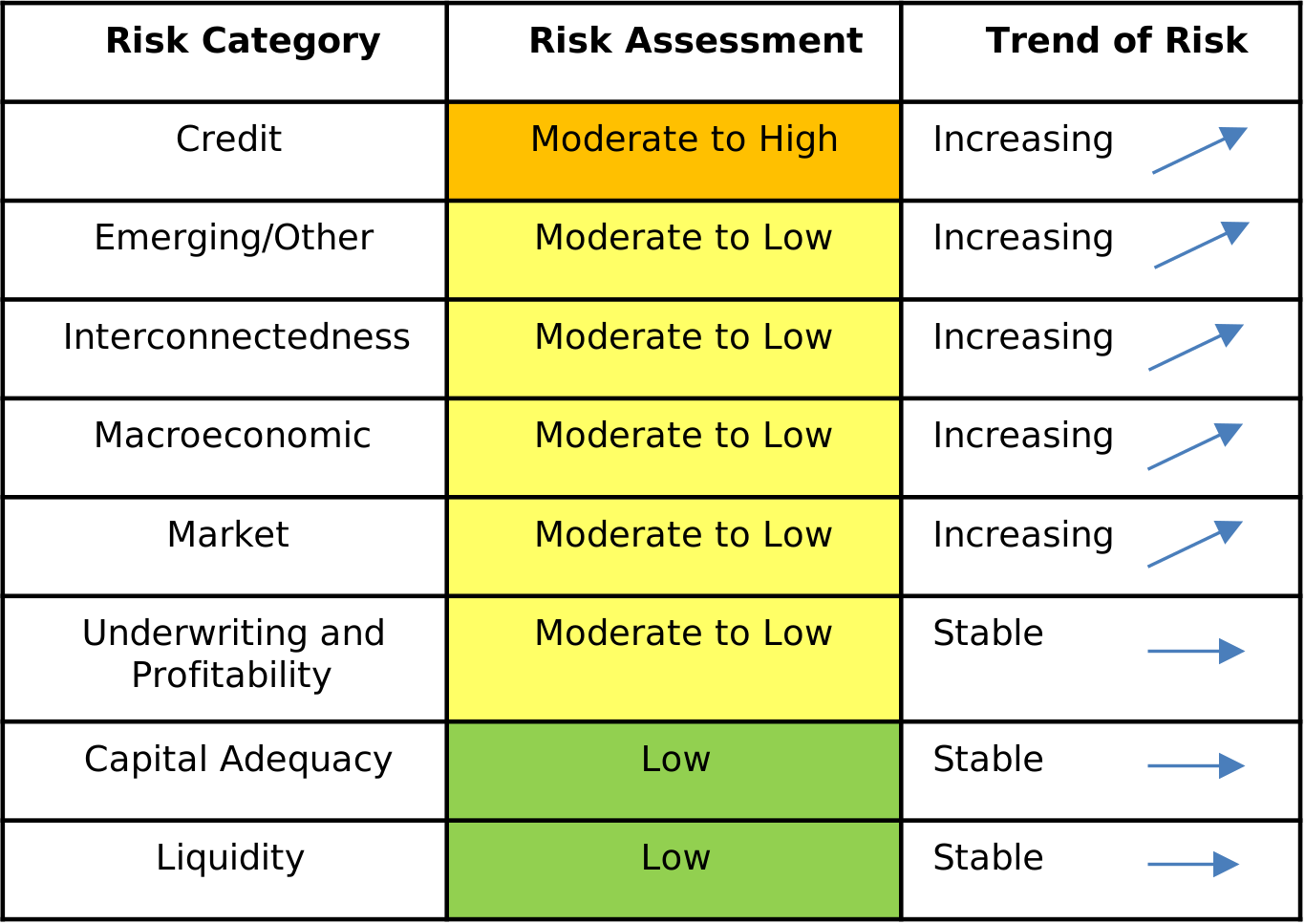 Dashboard, which helps regulators identify industry-wide vulnerabilities and potential systemic risks across eight categories and inform where additional regulatory monitoring may be warranted.
The latest assessment reinforces regulators’ focus on the interconnectedness of investment, liquidity, capital, and broader market risks. Regarding investment portfolios, regulators noted the rapid growth of private credit and the associated challenges around transparency, valuation, and quantifying insurer exposure. Level 3 assets were also added as a new market risk indicator, with exposure reaching 17% of insurers’ cash and invested assets and prompting further review by the Invested Assets Task Force throughout 2026.
The dashboard also highlighted significant shifts within the life sector, including increased use of complex investments, affiliated asset managers, and asset-intensive and cross-border reinsurance, as well as greater operating leverage through funding agreements and other financing activity. Beyond investments, regulators continue to monitor elevated risks within the health sector, natural catastrophe exposure, inflation, and interest rate trends. While the detailed dashboard remains regulator-only, the NAIC plans to publish a summary report highlighting its assessment of key industry risk exposures and the factors driving those conclusions.
Credit Rating Provider (CRP) Due Diligence Framework Takes Shape
The NAIC continues to develop its CRP Due Diligence Framework, which would establish a formal quantitative and qualitative assessment of rating agencies whose ratings are used for NAIC designations. Rather than treating all approved CRP ratings equally, the framework would allow regulators to evaluate individual CRPs and their methodologies and determine whether underlying ratings are appropriate for the Filing Exempt (FE) process.
Separately, the NAIC noted that the technology behind their ability to exercise discretion over NAIC designations assigned through the FE process is now operational.
CLOs Treatment Nears Finish Line
The Invested Assets Task Force shared a proposal to change the filing-exempt treatment of CLOs, with comments due September 14th, as the NAIC advances its work on underlying CLO RBC methodology. The Investment Designation Analysis Working Group received proposed revisions to the Purposes and Procedures Manual addressing the modeling of CLOs and assignment of NAIC designations. The work complements the NAIC’s broader effort to recalibrate capital treatment for CLOs and reflects regulators’ desire for greater differentiation of risk across the capital structure.
Regulators also considered how CLOs should interact with the FE process as the new methodology is implemented. Taken together, the proposals represent an important transition from the current ratings-based framework toward a more NAIC-specific approach to evaluating CLO risk. Insurers should continue to monitor the proposals closely given the potential implications for NAIC designations, RBC treatment, and relative value across CLO tranches.
PBBD Guidance: Further Clarifications for ABS
The Statutory Accounting Principles Working Group’s (SAPWG) latest discussion of Principles-Based Bond Definition (PBBD) focused on the treatment of asset-backed securities (ABS) and how the PBBD requirements should be applied when assessing if a structure qualifies for Schedule D-1 reporting. The guidance reinforces that classification depends on the economic substance of the transaction, the source of repayment and, where applicable, whether the structure provides sufficient substantive credit enhancement.
The ongoing clarifications illustrate that PBBD implementation is an evolution rather than a one-time accounting change. For insurers, the analysis supporting bond classification—and the documentation used to demonstrate compliance—will remain important as regulators work through more complex ABS structures.
Permanent Negative IMR Guidance Postponed as Interim Treatment Extended
Regulators continued work toward a long-term framework for negative Interest Maintenance Reserve (IMR), an issue particularly relevant for life insurers given the recent rise in interest rates. The NAIC has been evaluating how much negative IMR should be admitted as an asset and how that treatment should interact with other parts of the statutory framework.
Alongside this work, regulators advanced a “proof of reinvestment” concept that will provide greater visibility into the economics underlying realized interest-rate-related losses. SAPWG previously adopted the underlying concepts and directed NAIC staff to work with the industry to refine proposed reporting templates that would demonstrate whether proceeds from securities sold at a loss were subsequently reinvested.
In Columbus, regulators directed NAIC staff to partner with PwC on a revised framework. If implemented, the identity of the rating provider—and potentially its methodology—could become increasingly relevant to regulatory treatment.
Together, the initiatives reflect the challenge of balancing the economic rationale behind IMR—which spreads realized interest-rate-related gains and losses over time—with the NAIC’s emphasis on conservative statutory balance-sheet treatment. For insurers, a proof-of-reinvestment requirement could introduce additional documentation and reporting around portfolio turnover, while providing regulators with greater insight into whether realized losses and subsequent reinvestment activity are consistent with the intended purpose of IMR.
Residential Mortgage Loan Reporting May Become More Granular
Residential mortgage loans have also attracted regulatory attention as insurer exposure to the asset class has grown. Earlier this year, the Investment Analysis Working Group reviewed existing insurer exposure and referred questions around the definition, disclosure, and RBC treatment of residential mortgage loans to other NAIC groups.
The work reflects the increasing variety of residential mortgage investments held by insurers and the limitations of existing reporting categories in distinguishing among their underlying characteristics. Regulators are considering if additional reporting detail could provide greater visibility into these exposures and support more risk-sensitive capital treatment. While the project remains under development, additional granularity could eventually affect both statutory reporting and the way regulators assess residential mortgage loan risk across insurer portfolios.
Private Credit Growth Puts Level 3 Assets in Focus
The growth of private credit and other less-liquid investments in insurer portfolios continues to warrant regulator attention. The Invested Assets Task Force heard a presentation on the recent growth of certain Level 3 assets, with a particular focus on their reporting and audit treatment.
The Investment Analysis Working Group spent a significant amount of time at the Summer Session discussing private investment and level 3 assets as their exposures continue to increase within insurer portfolios. Their reliance on significant unobservable inputs when determining fair value makes valuation governance particularly important. Their growth within insurer portfolios has raised questions around transparency, consistency of valuation practices, and regulators’ ability to evaluate the underlying risks. Regulators noted that reporting currently varies substantially across insurers, making it difficult for them to compare portfolios due to the inconsistencies or trace Level 3 values back to statutory investment schedules.
As the regulatory body works to educate commissioners more on the nuances of the asset class, we expect more regulator attention to be focused on valuation methodologies, reconciliation between investment schedules and fair value reporting, and the independent ability for auditors and regulators to understand the valuation. As privates continue to be used as a yield-enhancement strategy, data quality and valuation documentation are moving from an accounting back-office issue to a larger part of portfolio risk management.